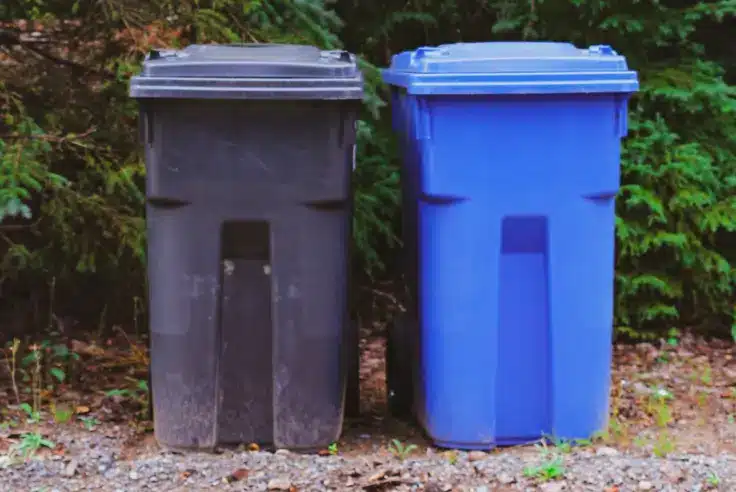

Once a box is flattened and placed in the recycling bin, a fair question remains, though: does that material actually become something new, or does it disappear into a system no one can see?
At Circular Services, we can offer a clear, specific answer. Once recycled cardboard leaves the bin, the fiber (the industry term for paper and cardboard material) follows a traceable path from our Materials Recovery Facilities (MRF) through to the mills where it is processed into new products.
Sorting and Baling
Every load of curbside recycling that enters our MRF is processed through a mix of optical scanners, screens, and trained staff who pull fiber away from glass, metal, and plastic. Cardboard and paper move fast through this line since they are flat, two-dimensional materials that ride and sort differently than the rigid, three-dimensional containers around them, which makes them easier to separate cleanly.
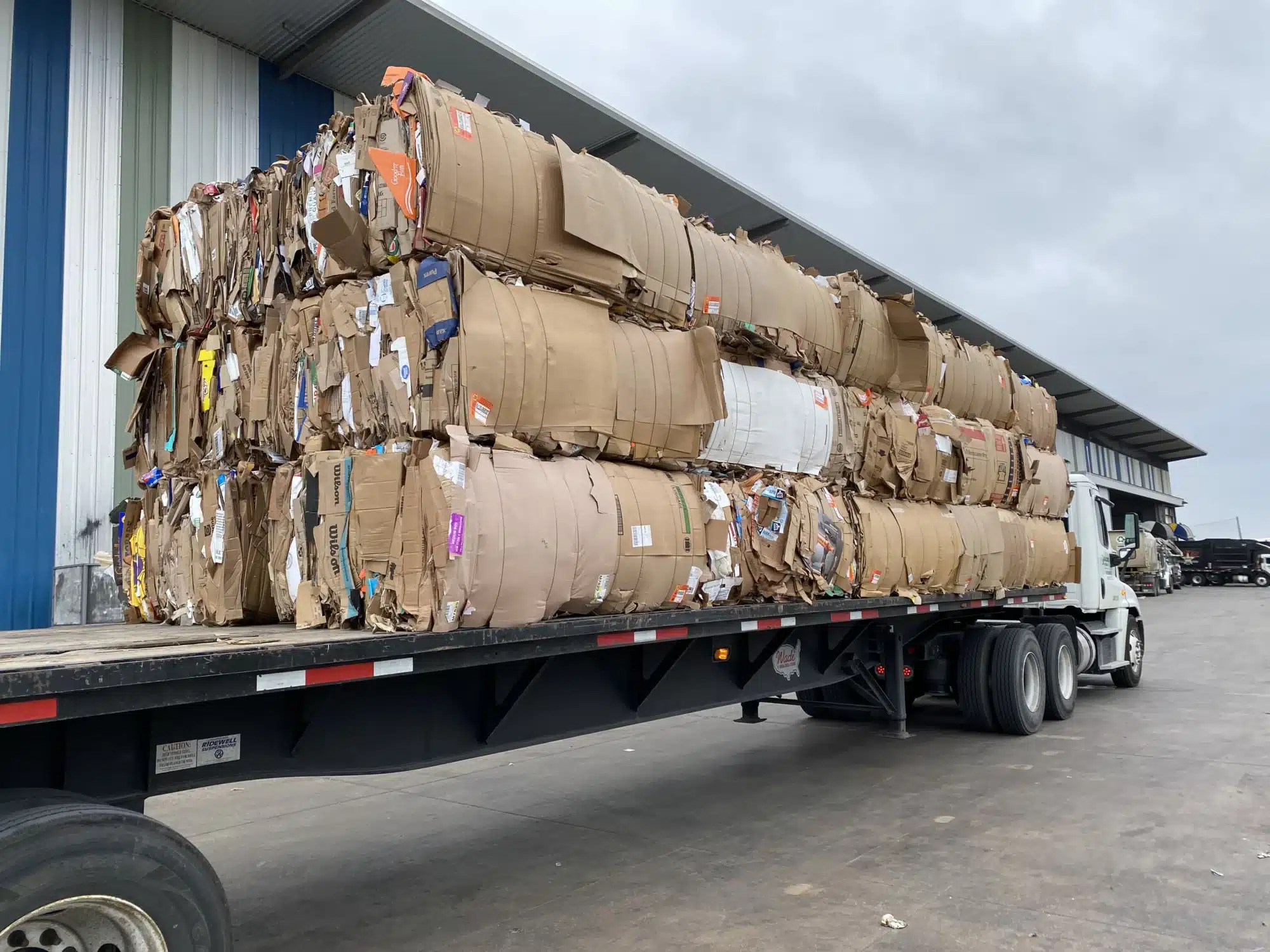
Once sorted, fiber gets compacted into bales. A single bale can weigh over half a ton, and it is the unit everything downstream is built around: buyers price by the bale, mills load by the bale, and our own tracking systems follow material by the bale. This baling step is really the starting line for the whole fiber recycling process that follows.
Grading: Not All Fiber Is the Same
A common misconception is that recycled paper is processed as a single, homogeneous stream. In practice, fiber is classified into distinct grades, with each grade determining its subsequent eligible applications.
OCC (old corrugated containers) is your shipping boxes and cardboard packaging. It is the highest-volume grade we handle and one of the most valuable, since OCC converts cleanly back into new boxes.
Mixed paper includes everything from junk mail to magazines to cereal boxes. It is a broader category with more variability.
Sorted office paper is one of the cleanest grades we produce. Given its low contamination and higher-quality fiber composition, it requires minimal additional processing before use in premium paper products.
Grading is not a mere formality. According to REMA’s ISRI Specifications Circular, contamination limits are strictly defined: off-grade paper mixed into a bale (“outthrows”) is typically capped at 2 to 5 percent, while non-paper contaminants (“prohibitives”) are typically capped at 0.5 to 1 percent. Exceeding either threshold results in the bale being rejected, leading to wasted transport costs and a disruption in the supply chain. Achieving the correct grade on the first attempt is essential to keeping material flowing efficiently.
How Bales Find a Buyer
This is the aspect most people never see: after grading, bales are not simply shipped to “a mill.” They are matched to specific buyers through a commodities network.
Circular Services maintains relationships with paper mills across the country. Which mill takes which bale depends on a handful of shifting factors: fiber grade, the mill’s current production needs, market pricing, and how far the material has to travel.
This is also why traceability is so important to us. We track which mill received each bale, and approximately when it left our facility, so when a municipal partner or business partner asks where their recycling ultimately ended up, we are able to provide a definitive answer.
Pulping and Deinking: Where Cardboard Becomes Pulp Again
At the mill, the paper pulping process starts with bales getting loaded into a pulper, essentially a giant vat that mixes the fiber with water and agitates it until the bales break down into individual fibers suspended in liquid.
From there, the pulp gets screened to remove staples, tape, and plastic film, then run through a deinking process for grades that need it (mostly mixed paper and office paper, since OCC rarely carries much ink to begin with). Deinking uses flotation and washing to strip out ink particles and coatings, leaving cleaner fiber behind.
That cleaned pulp is pressed, dried, and rolled into new paper or linerboard, ready to be converted into finished products.
What Fiber Becomes
Depending on the grade and the mill, recovered fiber turns into a range of recycled paper products, including:
- New corrugated boxes and shipping containers (the single biggest end use for OCC)
- Tissue products like paper towels and toilet paper
- Printing and writing paper
- Packaging for food and household goods, including cereal boxes and paperboard cartons
According to AF&PA, close to half of all recycled paper in the U.S. goes into making containerboard alone.
How Long Does the Entire Process Take?
Timelines vary by grade, mill location, and how quickly a bale gets matched to a buyer, but the typical loop from bin to new product is approximately five to six weeks. Some of that fiber moves faster: once a bale physically reaches a mill, the pulping-to-finished-roll process itself can take as little as two weeks. Most of the timeline is in matching, transport, and mill scheduling rather than the pulping itself.
Either way, that flattened box sitting in your recycling bin this week has a real shot at being a new box (or a roll of paper towels) on a shelf within a month or two.
The Bigger Picture
In 2024, the U.S. recycled around 46 million tons of paper, translating to a cardboard recycling rate of 69% to 74% and a paper recycling rate of 60% to 64%, according to AF&PA. That’s roughly 125,000 tons of recovered fiber turned into new products every single day nationwide.
None of that happens without the sorting, grading, and commodities matching that takes place long before fiber ever reaches a mill. That’s the part of the process Circular Services controls directly, and it’s the part that determines whether your recycling actually becomes something new.
Curious how this works for your community or your business? Contact Circular Services to learn more and see what happens after the truck picks up your bin.